WHITE PAPER: The 10X Return on EV Make-Ready Infrastructure in Central Chicago Condos
Executive Summary
In dense, garage-dependent Chicago condominium markets, dedicated EV charging is transitioning from a niche amenity to a measurable value differentiator. The value mechanism is primarily scarcity-driven: only a small fraction of for-sale listings explicitly market at-home charging attributes, and EV-friendly housing is disproportionately newer, implying that older condominium buildings lag in EV readiness.¹ [1] When supply is scarce and demand is rising, features that reduce friction for buyers become capitalized into price.
Empirical research supports the foundational premise that charging access is capitalized into housing values. A peer-reviewed hedonic and difference-in-differences study (California, 1993–2021; 14 million transactions) finds an average 3.3% price premium for homes within 0.62 miles of public EV charging stations, with a peak effect of 5.8% at approximately 0.25 to 0.31 miles.³ [2] The same study reports that apartment and condominium residents exhibit higher willingness to pay for charging access, consistent with the constraints of multifamily charging.³ [3] Although this evidence is not Chicago-specific and focuses on public stations, it is directly relevant for valuation logic: when charging is hard to obtain, access becomes more valuable.
Chicago listing evidence indicates that the market can price home charging explicitly at the parking-stall level. One central Chicago condominium listing offered two otherwise comparable garage parking options at different prices: $42,500 for a spot with a new EV charger versus $30,000 for a standard spot, a $12,500 delta.⁴ [4] That observed spread is directionally consistent with the concept that EV charging raises the market value of deeded or assigned parking rights.
This white paper provides a conservative pricing framework for typical central Chicago condos (modeled as a 1 bedroom and a 2 bedroom unit with garage parking) using premium assumptions of 1% to 4%, with a primary conservative case of 2%. These assumptions are used to quantify dollar uplift and compare it to a commonly cited incremental make-ready cost range of $800 to $1,000 per parking space (assumption stated explicitly in the analysis). Under these conservative scenarios, estimated value uplift multiples typically exceed 7x to 15x relative to make-ready cost, supporting the conclusion that make-ready infrastructure can pay for itself in resale value alone, even before considering time-to-sale benefits.
Evidence Base for Price Effects from Charging Access
Two complementary strands of evidence support the property-value thesis.
First, peer-reviewed housing economics literature finds that charging access is monetized in home prices. The Nature Sustainability–published study noted above estimates statistically significant price premiums associated with increased availability of EV charging stations.³ [2] Importantly for condominiums, the authors explicitly state that multifamily housing tends to have limited home charging capability and that apartment and condominium residents are willing to pay more for proximity to charging infrastructure.³ [3] This is directly aligned with central Chicago conditions, where private garages exist, but electrical capacity, governance rules, and retrofit complexity often constrain stall-level charging in older buildings.
Second, market behavior data indicates that EV charging is associated with improved marketability, which commonly supports price retention and negotiating leverage. A large-scale analysis by Zillow [5] found that listings featuring electric vehicle charging stations sold more than nine days faster than comparable homes.² [6] While time-on-market is not itself a price premium, in practical residential brokerage it is often correlated with reduced likelihood of price cuts, fewer concessions, and stronger buyer competition. The valuation implication is that EV charging can contribute to both price support and transaction liquidity.
Scarcity in Older Central Chicago Condominium Buildings
Scarcity as observed in listing disclosures
Nationally, only 0.9% of for-sale homes listed on Realtor.com [7] in 2023 were described as “EV-friendly,” up from 0.1% five years earlier.¹ [8] This is a small but rapidly increasing share; importantly, it reflects scarcity in the listing supply that is visible to buyers.
The same report finds that EV-friendly homes are materially newer than non-EV-friendly homes, with a typical EV-friendly home age of 6 years versus 29 years for a typical home without such features.¹ [9] This matters for Chicago condominiums because much of the dense urban condo inventory was built before widespread EV adoption and before EV-ready design practices were common. The age skew indicates that older buildings are structurally less likely to have embedded EV readiness, unless they have implemented a retrofit program.
Scarcity as a Chicago-relevant garage feature
The Realtor.com report also indicates that in colder-climate markets, including Chicago, more than 90% of EV-friendly listings include garages.¹ [10] This aligns with a core valuation point for Chicago condominiums: EV charging value is most readily monetized where there is secure off-street parking, and particularly where a space is deeded or otherwise attached to a unit’s use rights.
Governance and retrofit friction as a scarcity amplifier
In Chicago, scarcity is reinforced by retrofit friction. Reporting on the local market describes persistent barriers such as association rules and building limitations that can prevent or delay owner-installed chargers, even when a buyer is willing to pay for installation.⁷ [11] Those constraints create a sharp value contrast:
In buildings without a clear path to charging, EV owners may discount the unit due to uncertainty and future retrofit risk.
In buildings that are EV-ready or already EV-equipped, the buyer can treat charging as a solved problem, and such certainty tends to be capitalized into price and liquidity.
The consequence is a market segmentation effect where EV-ready buildings can attract a broader pool of buyers, while non-ready buildings risk functional obsolescence for a growing subset of purchasers.
Adoption trend timeline
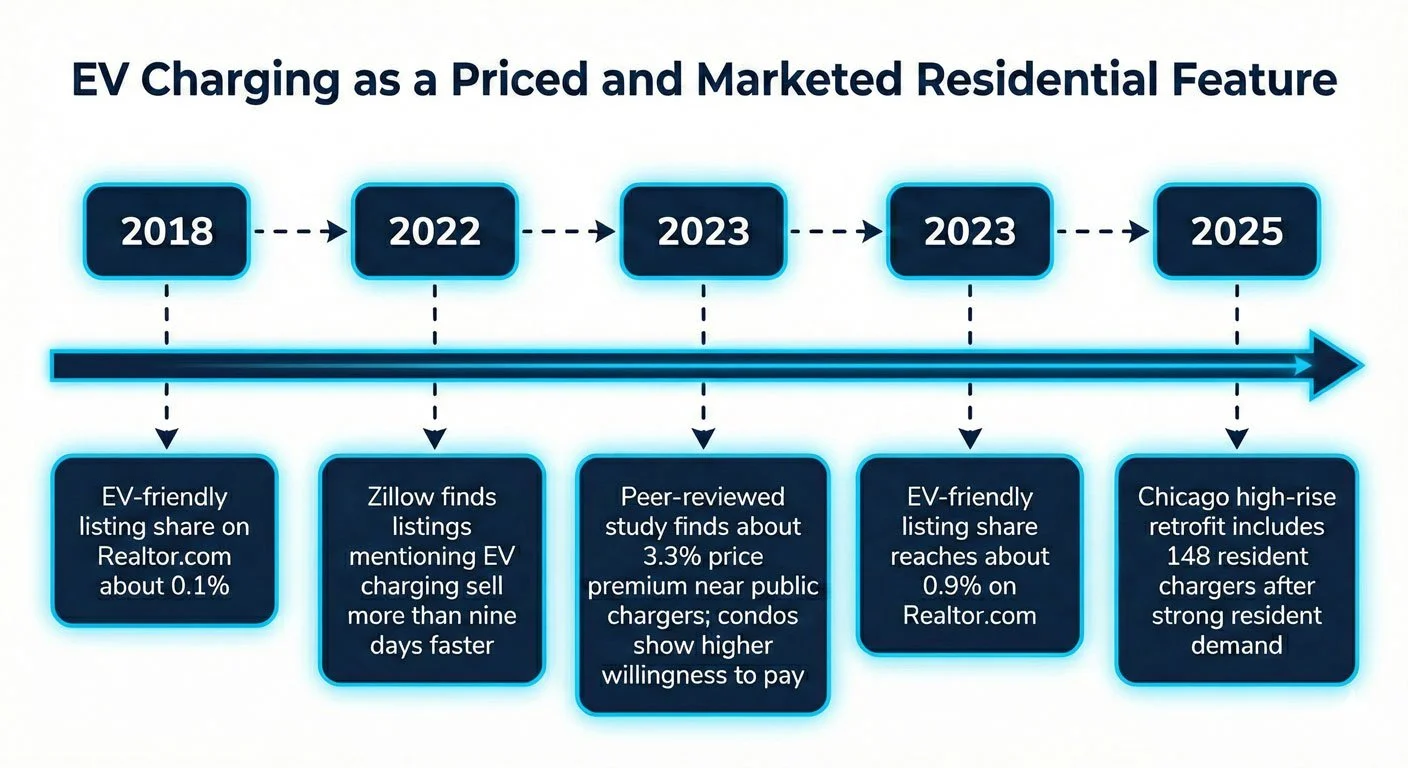
The following timeline synthesizes the adoption of EV charging as a marketed residential feature, using national listing evidence and a Chicago retrofit example.¹ ² ³ ⁹ [12]
Scenario Valuation Analysis for Typical Central Chicago Condominiums
Modeling approach and assumptions
This section quantifies value uplift for a “typical” central Chicago condominium context, focusing on neighborhoods such as River North [13], Streeterville [14], The Loop [15], and West Loop [16]. Local market medians across these areas typically fall in the high $300,000s to low $500,000s, supporting mid-market example valuations used here.⁶ [17]
Assumptions used for the illustrative cases are as follows:
Unit value, 1 bedroom and 1 bath: $350,000 (assumption; representative of central neighborhood price levels).⁶ [18]
Unit value, 2 bedroom and 2 bath: $600,000 (assumption; representative of larger-unit pricing in central high-rise submarkets).⁶ [19]
Garage parking value: $30,000 (assumption; consistent with observed listing and transaction evidence for central Chicago parking).⁴ ⁵ [20]
EV value premium: 1% to 4% applied to combined unit plus parking value (assumed range; primary conservative case is 2%).
Make-ready incremental cost per parking space: $800 to $1,000 (assumed cost range; treated as incremental conduit and electrical preparation cost, excluding building-wide service upgrades).
Definition note: make-ready is used here in the common multifamily sense, meaning that the electrical infrastructure is prepared so that an EV charging station can be installed with materially reduced cost and disruption. “EV ready” definitions commonly include wiring and outlets to support charger installation, beyond “EV capable” conduit-only approaches.⁸ [21]
Core results table
The table below compares baseline values to revised values under premium assumptions, then benchmarks the uplift against make-ready cost.
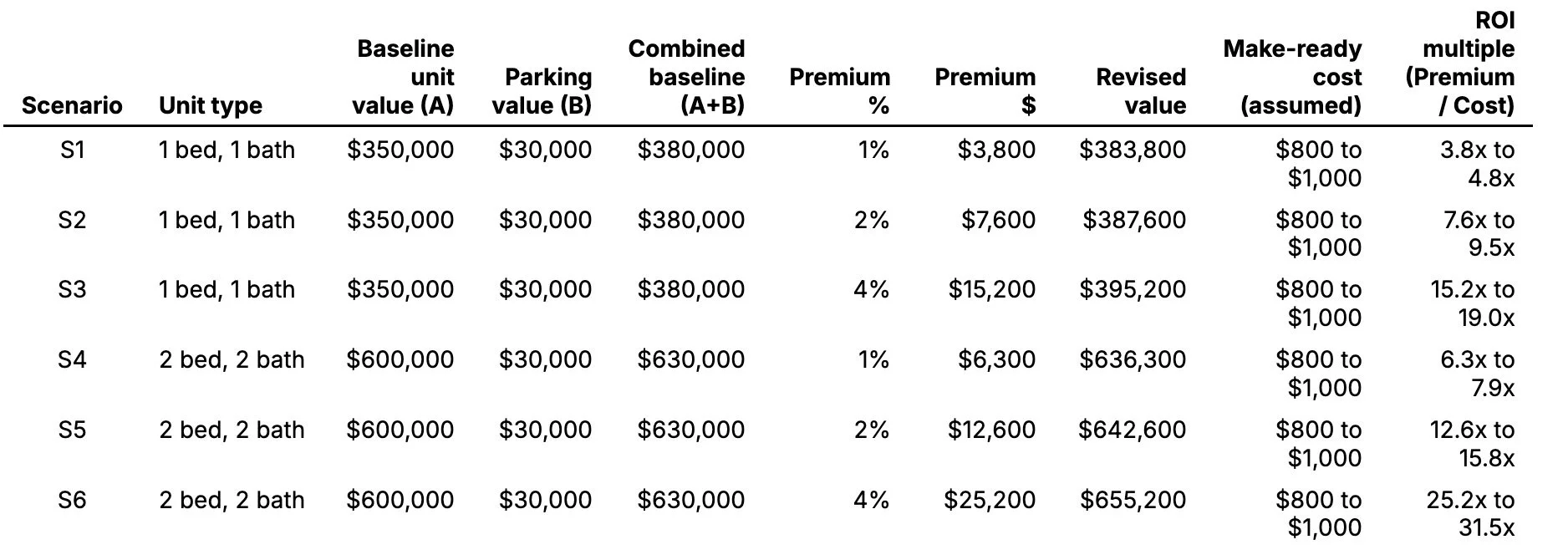
Interpretation: under the primary conservative assumption of a 2% premium, the implied value uplift is approximately $7,600 for a 1 bedroom and $12,600 for a 2 bedroom, compared to an assumed $800 to $1,000 make-ready cost per space. The implied payback multiple is therefore approximately 7.6x to 15.8x, depending on unit type and the assumed cost within the $800 to $1,000 range.
Chicago parking-stall market signal example
One Chicago listing explicitly priced an EV-equipped stall above a standard stall: $42,500 for a garage space with a new EV charger versus $30,000 for a comparable garage space, implying a $12,500 delta.⁴ [4] This is not a controlled study and reflects an asking structure rather than a verified sale premium, but it is a direct example of how EV charging can be monetized as a discrete parking asset.

Why Value Uplift Occurs in Deeded and Assigned Parking Contexts
The valuation impact in Chicago condominiums is best understood as a combination of buyer utility, reduced uncertainty, and scarcity pricing. Three mechanisms matter most.
First, EV charging directly increases the utility of a parking space or parking right. In dense neighborhoods where curbside or public charging can be uncertain, a dedicated charger converts parking from a storage amenity into an energy amenity. Empirical evidence indicates that households capitalize charging access into price even when the access is to nearby public infrastructure, implying that privately controlled access can be similarly or more valued for households that depend on consistent charging.³ [22]
Second, EV readiness reduces retrofit and governance uncertainty. In older buildings, buyers often must account for association approvals, electrical capacity analyses, metering arrangements, and potential future assessments. Chicago reporting confirms that building limitations and association rules can obstruct installations, creating real risk for EV-owning buyers.⁷ [11] A space that is already EV-ready or EV-equipped removes that uncertainty and may avoid a “buyer discount” associated with functional obsolescence.
Third, EV-ready features increase market visibility and shorten time on market, which can translate into higher realized prices. Homes with EV charging stations sell faster in national analysis, suggesting demand sensitivity to this feature.² [6] Separately, listing-based measures show that EV-friendly homes remain scarce and skew newer, reinforcing that EV capability in older stock is a differentiating attribute rather than a commodity.¹ [23]
Practically, the premium can appear in different places depending on how parking is structured:
If parking is a separate deed or separately priced add-on, the value uplift may be concentrated in the parking asset, which is consistent with the Chicago listing example.⁴ [4]
If parking is not separately priced, the premium may manifest as higher unit pricing, stronger buyer interest, or reduced concessions due to improved marketability.² [6]
Limitations and Sensitivity Notes
This paper is intended as a conservative valuation framework rather than a formal appraisal.
The premium values used in the scenario table (1% to 4%, primary 2%) are stated assumptions, selected to be conservative and to match the assumed range. The peer-reviewed evidence supports the broader proposition that charging access is capitalized into prices and that multifamily households may value charging access more, but the underlying estimates are not Chicago specific and are derived from public charging proximity rather than unit-level private chargers.³ [22] Accordingly, Chicago-specific realized premiums may be lower or higher, depending on building type, neighborhood, and implementation quality.
The make-ready cost range of $800 to $1,000 is treated as an incremental per-stall cost assumption. Actual costs vary significantly across older buildings, particularly where service upgrades, panel replacements, or major conduit pathways are required. Where make-ready requires extensive electrical work, ROI multiples will compress. Where a building can efficiently deploy make-ready at scale, multiples can remain high.
Finally, observed listing evidence of parking price differentials should be interpreted as illustrative. The $12,500 delta example is informative because it is a market quote, but it is not a controlled counterfactual and may embed other differences.⁴ [4]
Sources
¹ Realtor.com [7] Economic Research. “2024 Realtor.com Housing Market and Electric Vehicle Report” (Apr 10, 2024). [24]
² Zillow [5] Research. “Listings Highlighting Eco-Friendly Features Sell up to 10 Days Faster” (Apr 18, 2022). [6]
³ Liang, Jing; Qiu, Yueming (Lucy); Liu, Pengfei; He, Pan; Mauzerall, Denise. “Effects of expanding electric vehicle charging stations in California on the housing market” (working paper version hosted by Cardiff University; published in Nature Sustainability, 2023). [25]
⁴ Redfin listing disclosure for 520 S State St Unit 1626, Chicago, IL. Parking availability described as $42,500 for a spot with a new EV charger versus $30,000 for another spot (capturing a $12,500 differential). [4]
⁵ Redfin sale record for 405 N Wabash Ave Unit D67, Chicago, IL 60611. Sold Aug 29, 2025 for $23,000 (assigned parking space sale). [26]
⁶ Redfin neighborhood market summaries for central Chicago areas, used to support representative “typical” condo valuation assumptions (January 2026 medians): River North ($439K), Streeterville ($515K), West Loop ($535K), Downtown Chicago ($439K), The Loop ($370K). [17]
⁷ Axios [27] Chicago. “Home EV chargers are hot commodities in Chicago” (May 11, 2024). Used for evidence on local constraints such as association rules and building limitations affecting installation feasibility. [11]
⁸ K&L Gates. “New Illinois Laws for 2024 Affecting Real Estate” (Mar 14, 2024) describing EV-capable versus EV-ready parking distinctions in the context of Illinois requirements. [21]
⁹ Epic Charging [28]. “600 Lake Shore Drive Condominium Association EV Charging Case Study” (accessed 2026). Used for a Chicago-scale adoption signal: more than 25% of units opted for EV charging and 148 chargers were installed for resident parking spaces. [29]