
EV Charging Strategies for Multi-Family Buildings in Chicago and the Suburbs
Independent planning for boards and property managers. Free Initial Assessment with a board member referral.
Why Ready EV Now?
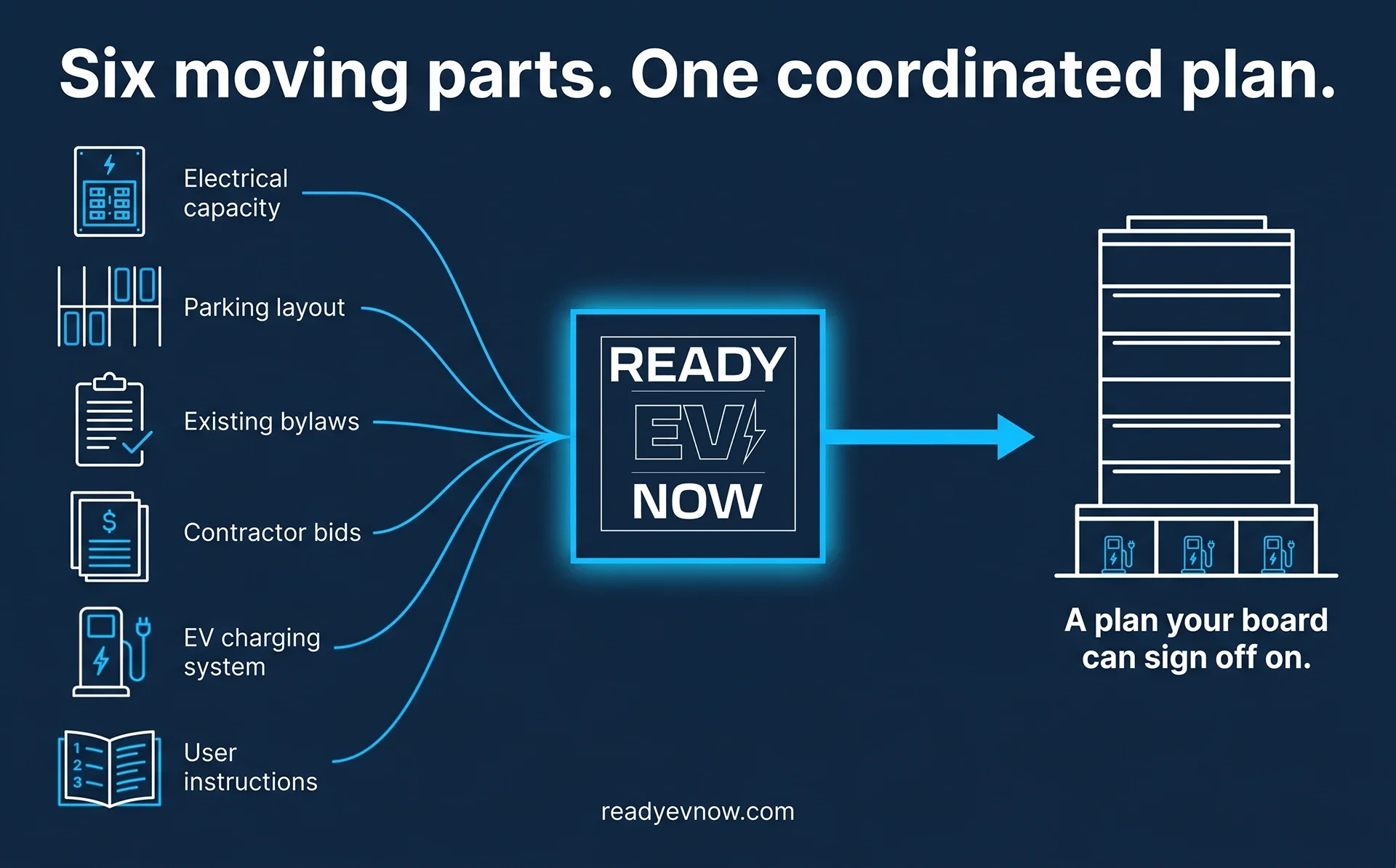
Ready EV Now was created to address a common gap in EV charging projects for multi-family buildings: truly independent, technically grounded advice that is not tied to any charging equipment provider or installation contractor. This independence allows associations to evaluate options objectively and make decisions that serve the building and its residents first.
Our experience spans mid-rise and high-rise residential buildings, shared parking structures, and owner-allocated parking environments. The focus is on clear analysis, practical planning, and decisions that remain workable over time.
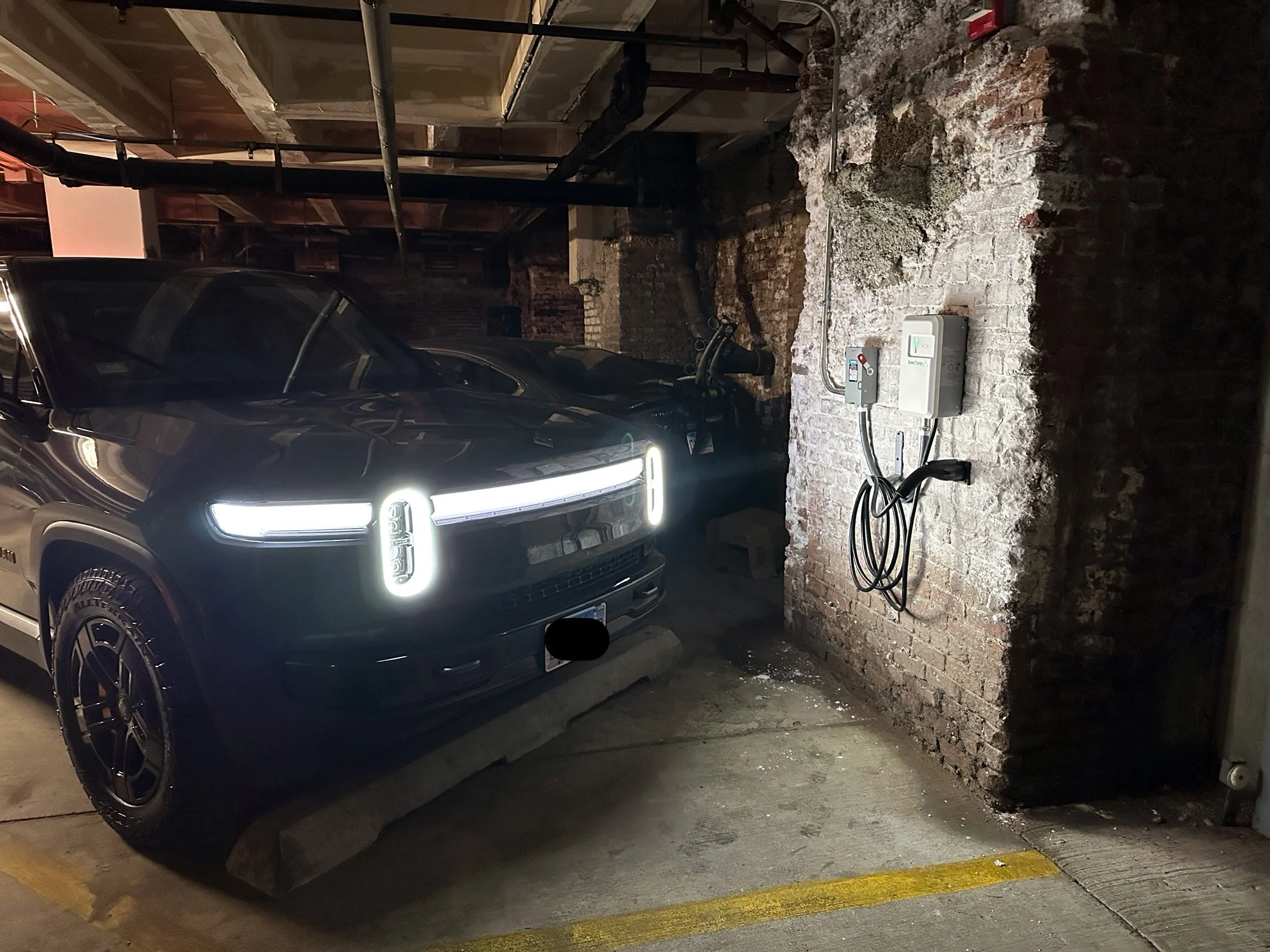
“Chris served as the manager for our EV make-ready project, expanding our electrical grid’s capabilities into our parking garage. He helped us navigate Association requirements and ensured a professional quality installation. As a result, our parking spots are now capable of having EV chargers installed at a uniform cost for each parking spot, enhancing their value and the value of the condo units in our building.”
How It Works
Introduction
A resident introduces Ready EV Now to the board, or the board reaches out directly.
Engagement Letter
The board signs and authorizes the Initial Assessment.
Initial Assessment
We deliver a written report of existing conditions and information gaps in one to two weeks.
Next steps
The board authorizes any subsequent service through a Statement of Work.
Our Services
Core Packaged Services

Initial EV Infrastructure Assessment
Existing-conditions review that establishes the baseline for planning.
Free with a board member referral. $500 otherwise.

EV Infrastructure Strategy
Turns the Assessment into a planning framework the board can act on.
Quoted per engagement.

HOA Bylaws Amendment Support
Drafting input for the board's counsel. Identifies the rules that have to change before EV charging can be authorized.
Quoted per engagement.

RFP and Vendor Management
Develops the RFP, evaluates vendor responses, and recommends a selection. The board decides.
Quoted per engagement.
Additional Services
Additional services are scoped and quoted on request. Each is authorized through its own Statement of Work.
Scaled Architectural As-Built Drawings*
Field measure and develop plans of the existing parking areas.
Document Main Electrical Circuitry*
To aid in the electrical engineering hand-off, record existing infrastructure data.
Construction Contract Review and Redlining
Review and coordinate contract revisions among parties involved.
Source Electrical Engineer
Identify and hire an Electrical Engineering firm to develop stamped electrical as-builts.
Assist in Gathering ComEd Usage Data
Collaborate with HOA board members to extract required usage data.
*These are draft, unofficial documents to aid discussions with licensed professionals.
Engagement Terms
The Initial Assessment is authorized by a signed Engagement Letter. Every subsequent service is authorized through its own Statement of Work. A refundable $500 Engagement Deposit applies to each Statement of Work and credits against the first invoice.
Professional Scope and Collaboration
Ready EV Now provides independent EV charging consulting services informed by hands-on experience with multi-family and HOA environments. While the firm does not offer licensed architectural, engineering, or legal services, recommendations are developed to support and coordinate with licensed electrical engineers, qualified installers, and other professionals engaged by the association as needed.
The firm is not affiliated with EV charging service providers, equipment manufacturers, or installation contractors, allowing guidance to remain objective and vendor-neutral.
Frequently Asked Questions
-
The Initial EV Infrastructure Assessment is free with a board member referral. Without a referral, the Assessment is available standalone for $500. The referral pathway aligns the engagement with the people who actually decide whether the project moves forward.
-
A referral is any written introduction from a sitting board member, a board officer, or a property manager retained by the association that puts Ready EV Now in front of the board. The introduction can originate from a resident, an owner, or the board member directly. What matters is that the board knows the firm is in the conversation and that the introduction is documented.
-
One to two weeks from receipt of the documentation Ready EV Now requests at intake. The timeline depends mostly on how complete the building's existing documentation is. Buildings with current as-builts and one-line diagrams move faster than buildings that need to gather them.
-
The Assessment names the gaps that have to close before strategic planning can proceed. Most clients then engage the EV Infrastructure Strategy or one of the supporting services (RFP and Vendor Management, HOA Bylaws Amendment Support) under a Statement of Work scoped to their property's specific needs. The Assessment makes that follow-on work efficient and defensible because the inputs are known.
-
The Strategy turns the Assessment's findings into a planning framework the board can promote to residents, to counsel, and to future buyers. It identifies the right phasing of capital investment, the constraints that will shape vendor selection, and the policy changes the bylaws need to support installation. Without the Strategy, projects often stall at the first hard question from a resident or a counsel review.
-
Savings depend on the building's starting condition, but a well-planned make-ready program reduces per-space installation cost and compresses what otherwise becomes years of stop-and-start board cycles into a single planned implementation. The Ready EV Now case study walks through a realized example with specific numbers and timeline.
-
Research on EV charging and multi-family property value suggests a meaningful premium for installed and rentable charging capacity, though realized premiums vary by city, building type, and the quality of the installation. Chicago-specific premiums fall in line with that range based on early transaction data, but they should be treated as estimates rather than guaranteed outcomes. The Ready EV Now white paper on EV infrastructure return walks through the assumptions and the supporting data.
-
Most multi-family buildings have more electrical headroom than they realize, but the answer depends on the panel sizing, the existing load profile, and how the chargers will be wired. The Initial Assessment reviews these specifically and produces a credible answer based on facts rather than a guess. Typically, an electrical engineer is involved to conduct a certified load analysis. In buildings where capacity is truly tight, the Assessment also identifies the load-management approaches that often defer or eliminate the need for an electrical upgrade.
-
Illinois has specific provisions governing how condominium and community association governance bodies may treat EV charging requests. The Condominium Property Act and the Common Interest Community Association Act both intersect with EV charging in ways that limit what associations may prohibit and that establish what they must reasonably permit. The HOA Bylaws Amendment Support service is built around these provisions and is the right entry point for boards trying to understand what they must allow.
-
The association typically owns and maintains the common-area infrastructure (main panels, sub-feeders, conduit pathways), while individual owners or residents typically own and maintain the charging unit at their specific parking space. Cost allocation between the two is governed by the building's declaration and bylaws, which is why amendments are often needed before a multi-space installation can be authorized. The right division varies by building, but a clean framework is a precondition for an installation that lasts.
-
Yes, and assigned or deeded parking is one of the most common situations Ready EV Now encounters. These ownership structures add governance complexity around who pays for installation, who maintains the equipment, and who owns the rights to use the charging point, but each is addressable through the bylaws amendment and infrastructure planning process. The Assessment establishes the technical baseline and the bylaws review establishes the governance baseline; together they make a per-space installation program workable.
-
Illinois law on EV charging applies to the property and the association or owner that controls it, not to the individual unit holder. As a renter, the path to a charger runs through your building's owner or property manager, who can engage Ready EV Now or another consultant on your behalf. The Illinois EV charging law white paper covers the rights and the process in detail.
-
Ready EV Now is not affiliated with charging equipment manufacturers, installers, or any vendor that might bid into a building's RFP. There are no commission arrangements, no preferred-partner agreements, and no incentive to favor one vendor over another. Evaluations and recommendations reflect only the board's stated criteria and the building's specific conditions.
Contact
Ready EV Now
If your association is evaluating EV charging or preparing for future demand, use the form below to start the conversation. You will receive a direct response outlining next steps and required information.