WHITE PAPER: Tired of Public EV Charging?
How Chicago Condominium Residents Can Request Home Charging Access
Executive Summary
Many condominium residents in Chicago own electric vehicles (EV) or are thinking of acquiring an EV but lack access to charging in their own parking space. As a result, they are forced to rely on public charging stations, which often require additional travel time, waiting, and higher per-kilowatt-hour costs. Over time, this inconvenience erodes many of the economic and lifestyle benefits that motivated EV ownership in the first place.
In condominium buildings, however, installing EV charging is not an individual decision alone. It requires coordination with the homeowners association (HOA), compliance with Illinois law, and alignment with City of Chicago permitting and electrical code requirements. While that prospect sounds ominous, it IS doable with the right help and planning.
This white paper explains how residents can move from routine public charging to a realistic path toward charging in their own building. It outlines what residents are entitled to request, how HOAs in Chicago typically evaluate EV charging proposals, and why initiating a shared make-ready infrastructure evaluation is often the most effective first step. A Chicago-appropriate sample letter to the HOA is included.
The Resident Problem: Time, Cost, and Inconvenience of Public Charging
For urban condominium residents, public charging often becomes the default rather than a backup option. Common challenges include:
Travel time to and from charging stations
Waiting for charger availability
Higher electricity costs compared to residential rates
Scheduling and charger service disruptions, particularly in winter
Reduced convenience relative to charging overnight at home
While public fast charging plays an important role in regional EV adoption, it is not designed to replace daily residential charging. For many condo residents, the lack of home charging becomes a persistent quality-of-life issue rather than a temporary inconvenience.
Why Charging at Your Own Building Is Different
Charging in your condominium parking space offers:
Lower per-mile operating cost
Predictable overnight charging
Reduced time spent driving solely to charge
Greater alignment with how EVs are intended to be used day to day
However, unlike single-family homes, condominium residents share electrical infrastructure and common spaces. This means solving the problem requires a building-level approach, even when the motivation begins with a single owner’s daily inconvenience.
Illinois Law: Your Right to Ask for EV Charging Access
Illinois law explicitly supports condominium owners seeking EV charging.
Under amendments adopted by the Illinois General Assembly, condominium associations may not unreasonably prohibit the installation or use of EV charging stations in individually assigned or limited common element parking spaces, subject to reasonable conditions.
For residents, this means:
You have the right to formally request EV charging access
The HOA must consider the request in good faith
The HOA may impose reasonable safety, insurance, and design requirements
The HOA controls shared electrical infrastructure and permitting coordination
The law supports access, but it does not bypass feasibility, safety, or planning requirements.
Chicago Realities That Affect EV Charging Feasibility
Even when the motivation is personal, implementation is shaped by Chicago-specific constraints.
Electrical Infrastructure
Many Chicago condominium buildings:
Were designed before EV charging demand existed
Have limited or undocumented spare electrical capacity
Serve garages through shared panels and feeders
Without an evaluation, it is impossible to know whether charging can be added safely or at what scale.
City of Chicago Permitting
All EV charging installations require:
Electrical permits through the City of Chicago Department of Buildings
Compliance with Chicago Electrical Code and fire safety standards
Installation by licensed electrical contractors
HOAs are responsible for ensuring compliance, even when an individual resident funds the work.
Two Ways Residents Typically Approach the Problem
Path A: Individual Charger Request
This approach focuses on solving one resident’s charging need and is most viable when:
The parking space is deeded or a limited common element
Electrical capacity is available nearby
The resident accepts full cost and maintenance responsibility
While permitted under Illinois law, this approach can be difficult if multiple residents later make similar requests.
Path B: Shared Make-Ready Infrastructure Strategy
This approach addresses the root problem by planning charging capacity once for the building. It is commonly favored in Chicago because it:
Reduces repeated construction in garages
Allows future residents to add chargers without major disruption
Manages electrical load more effectively
Protects long-term property value
Even residents motivated by immediate personal inconvenience often benefit from starting here.
Why Starting With a Shared Feasibility Evaluation Helps Everyone
Many HOAs are hesitant to approve individual installations without understanding broader implications. A make-ready feasibility evaluation allows the association to:
Determine whether home charging is technically achievable
Understand costs before residents invest individually
Avoid inequitable first-come outcomes
Plan for future demand rather than react to it
For residents, this step increases the likelihood that charging will be allowed, whether individually or building-wide.
Writing to the HOA: Framing the Issue Effectively
The most effective requests:
Start from the real resident problem of public charging reliance
Emphasize evaluation rather than immediate construction
Acknowledge HOA responsibility and risk management
Request professional assessment rather than exceptions
This framing aligns personal need with the board’s fiduciary duties.
Sample Letter to a Chicago Condominium HOA
Below is a sample letter that you can use as a starting point.
Subject: Request for Evaluation of EV Charging Feasibility to Reduce Reliance on Public Charging
Dear Members of the Board,
I am writing to request that the Association evaluate the feasibility of electric vehicle charging within our building. As an EV owner, I currently rely on public charging stations, which requires additional time and cost compared to charging at home. Access to charging in our parking facility would materially improve daily usability for residents like myself.
I understand that EV charging in a condominium setting involves shared electrical systems, City of Chicago permitting requirements, and long-term Association considerations. I am not requesting immediate approval for construction or a personal installation at this time.
Rather, I respectfully ask that the Board consider initiating a structured feasibility or make-ready evaluation to understand our building’s electrical capacity and potential options for supporting EV charging in a safe, compliant, and equitable manner.
I believe this approach would allow the Association to address resident needs while managing technical, legal, and financial risk, and would position the building well as EV adoption continues to grow.
Thank you for your time and consideration. I would be happy to assist with coordinating resident interest or supporting the evaluation process as appropriate.
Sincerely,
[Name]
[Unit Number]
[Parking Space, if applicable]
What Typically Happens Next
In Chicago condominiums, this request often leads to:
Board agenda discussion
Resident interest surveys
Commissioning a feasibility or make-ready assessment
Review with legal and engineering advisors
Development of an EV charging policy or roadmap
While the process may take time (measured in months or quarters not weeks), it creates a clear path away from ongoing reliance on public charging.
Conclusion
For condominium residents, repeatedly charging at public stations is a real and ongoing cost in both time and money. While Illinois law supports the right to request EV charging access, the most effective way to move from public charging to home charging is through coordinated planning.
Ready EV Now recommends that residents first request a shared infrastructure feasibility evaluation before pursuing a personal charger installation. When feasible, a make-ready strategy allows buildings to support EV charging in a scalable way, improves long-term property value, and reduces friction for both current and future residents.
Even when individual charging is the near-term goal, starting with a building-wide evaluation aligns resident needs with HOA responsibilities and creates a durable solution to the everyday inconvenience of public charging.
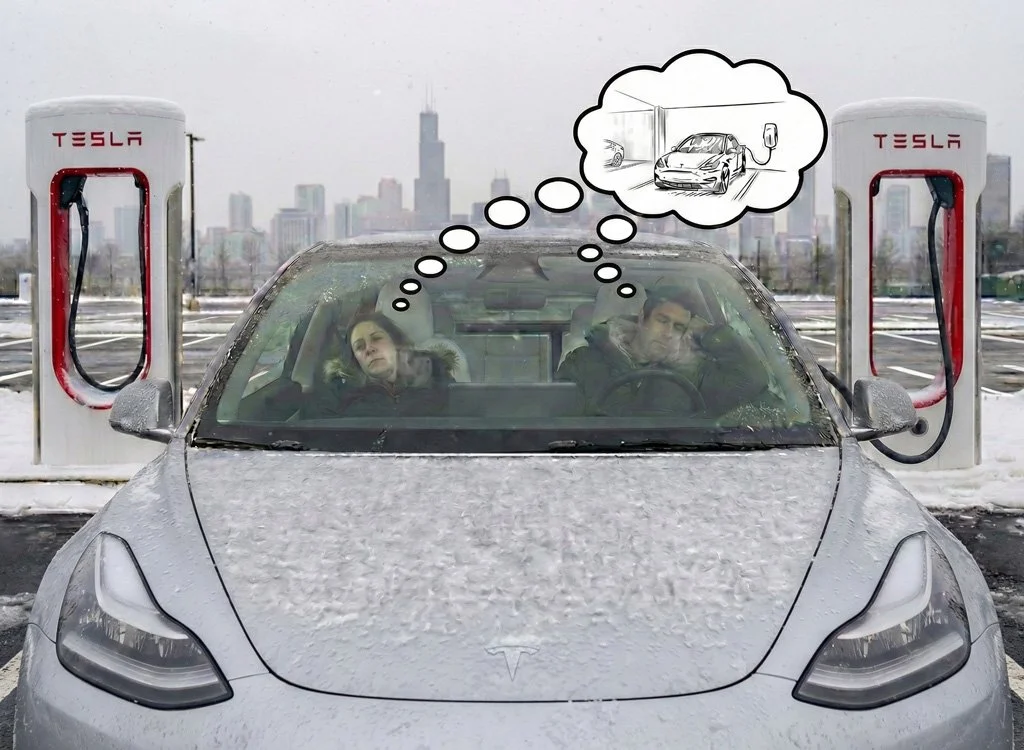
Figure 1. A man and woman waiting for their car to charge while dreaming of the idea to charge at home.