WHITE PAPER: Scalable Level 2 EV Charging for Chicago Multi-Family Buildings
With Open Parking and Minimal HOA Burden
Executive Summary
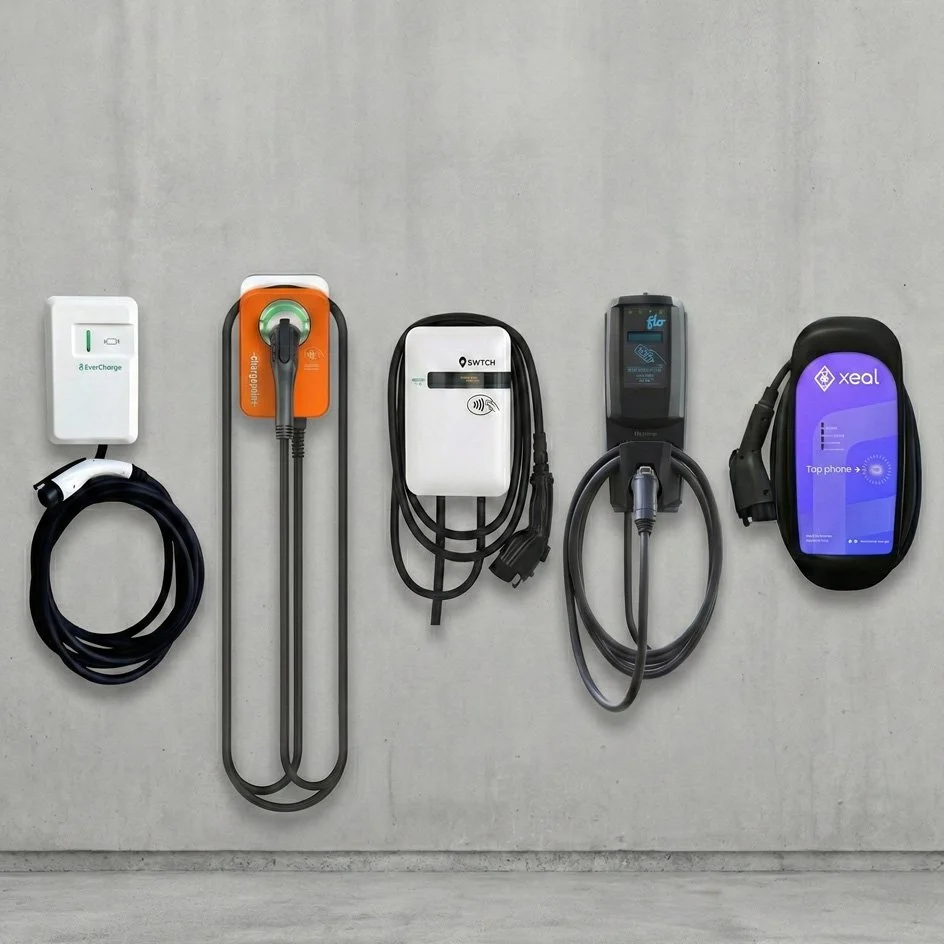
Chicago HOAs and residents can deploy Level 2 EV charging that works in open (shared) parking without turning the HOA into a utility or a daily charging “help desk,” provided the project is structured around two technical pillars: (a) networked user/account management with automated billing and reimbursement to the building, and (b) dynamic load management that lets many chargers operate on constrained electrical capacity without frequent service upgrades. Vendors including EverCharge, ChargePoint, SWTCH, FLO, and Xeal offer multifamily-oriented management systems with resident authentication, configurable pricing, reporting, and varying degrees of automated building reimbursement. The Illinois Electric Vehicle Charging Act reinforces the practical need for reimbursement mechanisms (embedded submetering or reasonable cost calculation) and timely approval processes, especially when charging is connected to common-area power.¹ Interoperability (notably OCPP) should be treated as a governance requirement, and not just a technical preference, because Chicago buildings have already experienced operational risk from proprietary ecosystems and abrupt network changes.
Chicago Multi-Family Requirements for Open Parking and “Hands-Off” Administration
Urban Chicago condominium and apartment parking commonly includes shared garages and common-area electrical meters. In open parking (unassigned stalls, valet/mixed-use areas, or “common area” charging), the system must prevent energy theft, allocate access fairly, and keep the HOA out of routine billing, support, and dispute resolution. Multifamily-ready Level 2 deployments therefore tend to succeed when they meet five requirements.
First, the charging system must support resident identity and authorization that work in open parking. ChargePoint explicitly positions its CPF50 as suitable for multifamily properties and notes that a networked installation enables property managers to control policies including “who can use the stations” and “how much drivers pay.”² ChargePoint’s mixed-use configuration is aimed at shared or mixed-use/valet environments, with the ability to set access control by driver groups or time-of-day and to use app-based station availability and waitlist.³
Second, billing must separate the end-user account from the building’s master electric bill and automate reimbursement to the building (or an HOA/condo board). ChargePoint’s Multi-Family Home Service states it “handles billing and remits 100% of the electricity fees back to the property or HOA,” combining this with “automated billing and reimbursement.”⁴ EverCharge’s apartment/condo solution likewise markets “fully-managed” operations and states it will “handle all billing and reimbursements,” reducing day-to-day HOA involvement.⁵
Third, load management must operate above simple “one circuit per stall” thinking. Chicago retrofits often face limited spare capacity and high cost for new feeders/transformers in dense downtown rights-of-way and high-rise electrical rooms. SWTCH describes its multifamily load manager as balancing charger demand with the rest of the property via “intelligent monitoring, dynamic scheduling, and second-by-second adjustments.”⁶ EverCharge similarly describes “full-building load management” and real-time allocation of power among vehicles without major upgrades.⁷
Fourth, the project must be structured to comply with Illinois law and reduce conflict. The Illinois Electric Vehicle Charging Act establishes legislative intent emphasizing charging access for residents of multi-unit dwellings and requires that associations not unreasonably delay approvals. It also directly anticipates reimbursement for electricity usage, which states that electricity costs can be based on an “embedded submetering device” or a reasonable calculation, and that reimbursement should not deliberately exceed reasonable reimbursement. These provisions align with systems that meter per-session kWh and automatically bill the resident account.
Fifth, interoperability should be required contractually. OCPP (Open Charge Point Protocol) is designed to enable communication between charge points and central management systems across vendors.⁸ SWTCH positions itself as explicitly OCPP-based and “vendor-agnostic,” emphasizing the ability to integrate new OCPP chargers and to switch hardware/software providers without putting the investment at risk.⁹ A Chicago example at 600 N Lake Shore Drive underscores why this matters: the site’s case study narrative describes loss of control risk tied to proprietary firmware and the need to migrate management platforms after a network disruption, highlighting vendor lock-in as an operational risk for multifamily properties.
Technical Foundation for Scalable Open-Parking Level 2 Charging
Billing and Reimbursement Architecture for Common-Area Power
For open parking, the most HOA-minimizing pattern is: the building supplies power (often from a common area meter), the charging network meters each user session, the platform bills the resident (card-on-file or invoice), and the platform reimburses the building (or nets out electricity fees and disburses revenue). ChargePoint’s multifamily materials repeatedly emphasize “billing and reimbursement” handled by ChargePoint, including both assigned and community/shared modes.¹⁰ ChargePoint’s “How it works” steps in assigned and community configurations show a five-step model encompassing pricing/access policy configuration, resident connection/approval, and ChargePoint payment processing and reimbursement to the property.
EverCharge’s apartment/condo solution overview describes a similar lifecycle: stations connect to common-area power; SmartPower allocates energy; usage monitoring tracks electricity consumed; and “automated billing and building reimbursements are issued by EverCharge.”¹¹ EverCharge’s multifamily page further describes multiple billing models (e.g., drivers paying monthly and/or per kWh, with site hosts setting public rates and funds disbursed after processing fees), reflecting configurable approaches to cost recovery without constant HOA administration.¹²
FLO frames its network services as inclusive of billing support, noting that its Global Management Services “take care of your billing process,” and describing an “owner web portal” to control access and view usage/revenue. These are capabilities that map directly to HOA reporting needs.¹³ FLO also describes an integrated payment system in which “FLO handles the entire billing process” once the fee is selected.¹³
Xeal positions its multifamily operations as “friction-free for residents and operators,” referencing “simplified billing” and dashboard reporting, while an EPRI/SCE emerging-technology summary describes Xeal’s platform as enabling EV drivers to pay for charging, reserve blocks, and apply additional fees for overstays. These are capabilities that are particularly relevant for open/shared parking where turnover policy matters.¹⁴ ¹⁵
Load Management as the Enabler of “Any Parking Space at Similar Cost”
In retrofit multifamily garages, the economic barrier is rarely the charger unit itself; it is the marginal electrical work per new stall. Load-managed designs reduce (not eliminate) expensive upstream upgrades by allowing a portfolio of chargers to operate under an aggregate site/panel/circuit limit. Vendors implement this in three common layers:
Circuit-level sharing (daisy chaining / circuit sharing) groups several chargers behind one circuit and divides the allowable current among active sessions. FLO emphasizes circuit-level configuration: PowerSharing can be configured “at the circuit breaker level” and is positioned as a convenience “when a dedicated circuit isn’t available for each charging station.”¹⁶ SWTCH’s load-management guidance similarly describes “circuit sharing” as a basic configuration used to add more chargers within circuit limits.¹⁷
Panel-/site-level dynamic management treats the EV charging system as an adjustable building load. ChargePoint describes power sharing as satisfying multiple constraints and ensuring that the sum of power across a station group never exceeds a specified limit, with selectable “fairness algorithms.”¹⁸ Its documentation describes circuit-, panel-, and site-level sharing, including an example where panel sharing can allow a larger number of stations on a panel without upgrading service, subject to configured limits.¹⁸ EverCharge positions SmartPower as “full-building load management,” able to respond to demand changes and peak loads and to increase charging capacity when other building systems are not in use.¹⁹
Building-aware scheduling and peak controls apply time-based or dynamic limits to avoid peak charges and coordinate with resident usage patterns. FLO’s PowerLimiting is described as automatically managing spikes during peak times, with options for fixed, scheduled, or dynamic limits.²⁰ Xeal’s EPRI/SCE summary similarly describes managing charging during peak demand periods based on building historical load profiles.²¹
For HOAs, the key point is that once a modest “make-ready” backbone exists (panel capacity allocation, conduit pathways, and standardized stub-ups), load management makes each additional stall more comparable in cost and avoids the “first few residents get charging, everyone else faces a major upgrade” trap.
See Table 1: Comparative Evaluation of Multifamily-Oriented Level 2 Vendors.
Vendor-Specific Evaluation Notes for Chicago Open Parking
EverCharge is structurally aligned with HOA minimization because it explicitly positions itself as “one vendor” covering hardware, software, installation, maintenance, billing, onboarding, and support. Its apartment/condo workflow explicitly ties common-area power to automated billing and building reimbursement. Its SmartPower messaging emphasizes building-level load management, including the ability to increase charging capacity when other systems are not in use. This is an important advantage in dense urban high-rises with limited electrical headroom. EverCharge also describes an OCPP approach that allows third-party CSMS use with EverCharge EVSEs, which if supported contractually for the multifamily product stack, could reduce long-term lock-in risk.²²
ChargePoint provides unusually clear documentation and operational workflows for multifamily, including assigned charging, community/shared charging, and mixed-use charging.²³ Its documentation is also unusually explicit about load sharing mechanics (circuit/panel/site levels and fairness algorithms), making it easier for HOAs to understand what they are buying and how scaling is achieved in practice.¹⁸ A governance caution is that ChargePoint’s multifamily resident agreement states that if the service agreement terminates, the station can be used as a non-networked charger without authentication, billing, energy management, or other network-enabled capabilities. This means that network services are not optional if the HOA wants the value propositions that reduce HOA workload.²⁴
SWTCH is best viewed as a multifamily-first management ecosystem that intentionally emphasizes OCPP and vendor-agnostic flexibility. It explicitly states that building managers receive a hands-off system through SWTCH Portal, including rate structures, loitering enforcement, turnkey billing, and reporting dashboards, and that SWTCH Control dynamically balances charger demand with the rest of the building.²⁵ SWTCH’s technology messaging is among the most explicit in linking open protocols to future migration flexibility (ability to integrate new OCPP chargers and switch providers).⁹
FLO’s value proposition in this context is its combination of durable commercial L2 hardware with clearly articulated energy management features: PowerSharing and PowerLimiting.²⁰ The CoRe+ Series page explicitly states that PowerSharing allows multiple stations to share available power and be configured at the circuit breaker level, and provides numeric examples (e.g., PowerSharing across sets of four stations).¹⁶ FLO also positions Global Management Services as providing an integrated payment system, owner portal for access control, and billing management.¹³ For HOAs, a diligence item is to verify precisely which CoRe+ variants are deployed and how OCPP is enabled in the chosen configuration; at least for CoRe+ Max, the installation manual lists OCPP 1.6J.²⁶
Xeal differentiates via a reliability approach that de-emphasizes Wi‑Fi/cellular dependency: it states chargers do not require Wi‑Fi or cellular networks to operate and uses “secure offline communication” between app and charger.²⁷ Xeal’s technology page states OCPP compliance, and its multifamily marketing emphasizes access control, dashboard reporting, automatic diagnostics, and simplified billing.¹⁴ ²⁷ The EPRI/SCE summary adds detail relevant to open parking: reservations, pay-for-blocks, and overstay fees, alongside peak demand management.¹⁵
Tesla’s commercial charging option is relevant primarily as a partial-fit alternative: it offers a Tesla Portal model with pay-per-use pricing and a stated $0.03/kWh fee for payment processing and remote troubleshooting support.²⁸ Tesla also documents “Power Management” features (static, dynamic, group), including group power management for up to six Wall Connectors.²⁹ However, Tesla’s access control documentation states it currently does not support access control for vehicles not produced by Tesla, which is a material limitation in open parking where mixed EV makes are expected.³⁰ While Tesla’s Universal Wall Connector appears on the Open Charge Alliance participant listing as OCPP 1.6 certified (subset),³¹ the practical governance question for HOAs remains whether the desired billing/access/load management workflow can be maintained under mixed-EV conditions and whether third-party CSMS integration is available and supportable at scale.
Chicago Case Evidence and the Interoperability Lesson for HOAs
EverCharge at 340 on the Park
EverCharge’s Chicago case study at 340 on the Park (Lakeshore East) describes a high-rise condominium selecting EverCharge after feasibility work, installing 38 chargers, accommodating 48 users, and claiming room to grow by at least 30% without power upgrades.³² The same case study states the building saved approximately $75,000 in infrastructure upgrade costs by leveraging a larger centrally located panel serving multiple floors.³² It also states that EverCharge handled operations “from quarterly billing to ongoing support,” highlighting the HOA workload reduction value proposition.³² For Chicago HOAs evaluating open parking, the key takeaway is that “scale without upgrades” is achievable when (a) a centralized electrical design is matched to (b) a platform-level load management system and (c) a billing/reimbursement system that avoids manual HOA accounting.
600 N Lake Shore Drive and the Vendor Lock-In Risk
A second urban Chicago example comes from the 600 N Lake Shore Drive condominium association, described as migrating 148 Level 2 chargers after a network disruption. The case study narrative describes the consequences of proprietary firmware and the vulnerability of charge point operators when a charging station management system is taken offline, and explicitly frames OCPP-compliant firmware and interoperability as the reason migration could occur.³³ Whether or not an HOA chooses the vendors in that case, the governance implication is robust: Chicago buildings should treat protocol openness and documented migration paths as risk controls, because service discontinuity can otherwise turn managed charging into unmanaged outlets overnight.
Cost framing and the modest infrastructure investment concept
Because the user request is to avoid installation cost breakdowns, this section provides only planning-level ranges for context.
Published commercial guidance commonly places Level 2 installed costs (equipment + installation) across a wide range (approximately $3,500 to $15,000 per port), driven by site conditions, distance to power, and whether major upgrades are needed.³⁴ ³⁵ For buildings that make a modest shared infrastructure investment (often called “make-ready”: panels allocated to EV, conduit pathways, standardized stub-ups or junction points), the incremental cost per additional parking stall trends toward the low end of those published ranges. In such “make-ready already in place” scenarios, an installed-cost planning assumption of roughly $3,500–$4,000 per stall is more consistent with the low end of published commercial ranges than older high anecdotal estimates, while acknowledging that actual Chicago project pricing remains quote-based and site-dependent.³⁴ ³⁴
The practical meaning for HOAs is that the building’s enabling investment should be structured to reduce per-stall variability: create a common electrical backbone and rely on load management to share capacity, rather than funding bespoke panel work for each new EV owner.
Incentives and rebates change frequently and should be checked locally at the time of procurement; this white paper focuses on technology and governance. Illinois’ Electric Vehicle Charging Act is the stable legal baseline Chicago HOAs should reference.¹
Sources
¹ Illinois General Assembly, Electric Vehicle Charging Act (765 ILCS 1085): legislative intent, applicability to existing buildings, association approval timelines, and reimbursement principles (including submetering or reasonable calculation).
² ChargePoint, “CPF50 Site Design Guide” (recommendation for multifamily; policy control; network features including access control and billing).
³ ChargePoint, “ChargePoint multifamily EV charging solutions” brochure: assigned, community, and mixed-use charging workflows; billing/reimbursement; access control and waitlist concepts.
⁴ ChargePoint, “Multi-Family Home Service” (billing remittance language and feature list).
⁵ EverCharge, “Solutions: Multi-Family” (billing/reimbursements and fully-managed framing).
⁶ SWTCH, “Multifamily Properties” (Portal features including access control, rate structures, loitering enforcement, turnkey billing; Control second-by-second load adjustments; OCPP/vendor-agnostic positioning).
⁷ EverCharge, “SmartPower” (full-building load management; respond to demand changes and peak loads).
⁸ Open Charge Alliance, “Open Charge Point Protocol (OCPP).”
⁹ SWTCH, “Technology” (built on OCPP; scalability via integrating new OCPP chargers; ability to switch providers).
¹⁰ ChargePoint, “ChargePoint multifamily EV charging solutions” brochure: assigned, community, and mixed-use charging workflows; billing/reimbursement; access control and waitlist concepts.
¹¹ EverCharge, “Solution Overview: Apartment and Condominium Charging Made Easy” (common-area power; SmartPower allocation; usage monitoring; automated billing and building reimbursement).
¹² EverCharge, “Solutions: Multi-Family” (billing/reimbursements and fully-managed framing).
¹³ FLO, “Global Management Services” (billing handled by FLO; integrated payment system; owner portal for access control and revenue/usage visibility).
¹⁴ Xeal, “Reliable EV Charging for Multifamily Communities” (access control, dashboard reporting, billing control claims).
¹⁵ EPRI / Southern California Edison Emerging Technologies Program summary report on Xeal (peak-period demand management; driver payment; reservations and overstay fees).
¹⁶ FLO, “CoRe+ Series” (PowerSharing configured at breaker level; multi-residential positioning; PowerSharing technical examples).
¹⁷ SWTCH, “Load Management: The Cornerstone…” (load management configurations: circuit sharing, dedicated panel sharing, mixed-load panel sharing).
¹⁸ ChargePoint, “Manage Energy” guide (power sharing concept: aggregate limit; circuit/panel/site levels; fairness algorithms).
¹⁹ EverCharge, “SmartPower” (full-building load management; respond to demand changes and peak loads).
²⁰ FLO, “Energy Management for EV Charging” (PowerSharing dynamic distribution; algorithm reallocation; PowerLimiting fixed/scheduled/dynamic limits).
²¹ EPRI / Southern California Edison Emerging Technologies Program summary report on Xeal (peak-period demand management; driver payment; reservations and overstay fees).
²² EverCharge, “Technology” (OCPP implementation allowing third-party CSMS use with EverCharge EVSEs).
²³ ChargePoint, “ChargePoint multifamily EV charging solutions” brochure: assigned, community, and mixed-use charging workflows; billing/reimbursement; access control and waitlist concepts.
²⁴ ChargePoint, “MultiFamily Resident Agreement” (loss of network-enabled features upon service termination).
²⁵ SWTCH, “Multifamily Properties” (Portal features including access control, rate structures, loitering enforcement, turnkey billing; Control second-by-second load adjustments; OCPP/vendor-agnostic positioning).
²⁶ FLO, CoRe+ Max installation manual (lists OCPP version 1.6J).
²⁷ Xeal, “Technology” (offline operation—no Wi‑Fi/cellular required; Helix Computing; OCPP compliance statement).
²⁸ Tesla, “Host Commercial Charging” support page (Tesla Portal; pay-per-use choice; $0.03/kWh fee for payment processing and remote troubleshooting support).
²⁹ Tesla, “Wall Connector Power Management” (static/dynamic/group power management; dynamic not usable across multiple wall connectors; group limited to Gen 3 Wall Connectors and up to six units).
³⁰ Tesla, “Wall Connector Access Control” (shared location rationale; current limitation for non-Tesla access control).
³¹ Open Charge Alliance participant listing for Tesla (Tesla Universal Wall Connector OCPP 1.6 certification entry).
³² EverCharge, “340 on the Park case study” (Chicago; 38 chargers; 48 users; 30% headroom; $75k savings; quarterly billing and support).
³³ Epic Charging, “600 Lake Shore Drive – EV Charging Case Study” (Chicago condo, 148 chargers; vendor lock-in framing; OCPP migration narrative).
³⁴ Qmerit, commercial Level 2 cost range statement ($3,500–$15,000 per port installed as an average framing).
³⁵ EVConnect, commercial Level 2 cost range table ($3,500–$15,000 per port).