WHITE PAPER: Cost Analysis for EV Make-Ready Infrastructure
for Mid-Rise and High-Rise Condominium Parking in Chicago, IL
Executive Summary
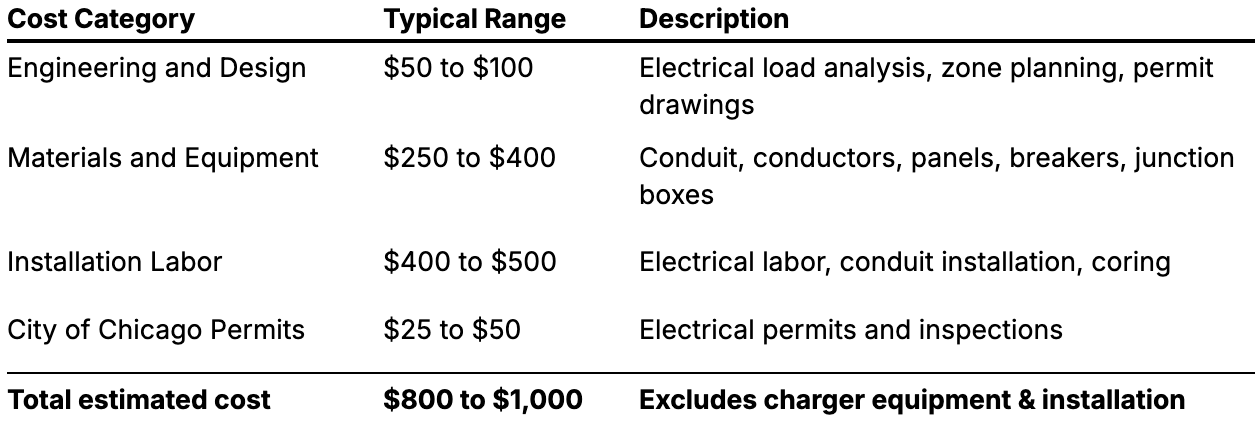
For existing mid-rise and high-rise condominium buildings in Chicago with 80 or more privately owned parking spaces, installing EV make-ready electrical infrastructure at the association level is the most cost-effective and equitable method for supporting long-term electric vehicle adoption. When planned at scale and coordinated with available building electrical capacity, typical make-ready costs range from approximately $800 to $1,000 per parking space.
Make-ready infrastructure establishes a standardized electrical backbone that allows individual unit owners to install Level 2 EV chargers at comparable future costs. Without this approach, charger installations occur incrementally, resulting in inconsistent costs, inefficient electrical layouts, and avoidable future retrofits. This paper evaluates typical retrofit costs in Chicago, including engineering, materials, installation labor, and municipal permitting, and explains why make-ready infrastructure is foundational to fair and scalable EV charging deployment.
Scope and Assumptions
This analysis applies to the following conditions:
Existing condominium buildings undergoing retrofit work
Parking areas consisting primarily of interior garages or structured parking
Parking spaces that are privately deeded
Level 2 EV charging intended for resident use
No charger equipment included in make-ready costs
Electrical service upgrades excluded unless specifically noted
Surface parking lots immediately adjacent to the building are addressed where relevant, but the primary focus remains structured parking environments common in Chicago.
Definition of Make-Ready Infrastructure
Make-ready EV infrastructure consists of all electrical work required to prepare parking spaces for future EV charger installation up to defined electrical endpoints, without installing the chargers themselves¹.
In multi-family residential buildings, those endpoints are best organized as charging zones.
Charging Zones
A charging zone is a defined group of parking spaces served by a shared electrical circuit or feeder that terminates at a zone-level junction box or subpanel. Individual chargers connect downstream of this endpoint and share available electrical capacity through load management.
A typical charging zone includes:
A feeder from main electrical service or switchgear
A garage-level EV panel or zone panel
Branch circuits serving multiple parking spaces (as zones)
Junction boxes for parking zones or stub-outs at each parking space
Zones commonly serve four to eight parking spaces, depending on circuit size and charging strategy. This structure allows chargers to share electrical capacity safely rather than assigning a full dedicated circuit to each stall.
Purpose and Equity Considerations
In condominium buildings, electrical infrastructure is a shared asset while parking spaces are privately owned. Without a coordinated make-ready approach:
Early EV adopters incur disproportionately high installation costs
Later owners benefit from infrastructure paid for by others
Electrical capacity is consumed inefficiently
Future expansion becomes increasingly expensive and disruptive
Make-ready infrastructure addresses these issues structurally. By funding infrastructure to every parking space or zone in advance, the association ensures that future charger installations carry similar costs for all residents. This improves cost equity, simplifies governance decisions, and avoids repeated construction within the garage².
Typical Cost Breakdown Per Parking Space
The following cost ranges reflect Chicago-area retrofit projects involving 80 or more parking spaces, assuming adequate existing electrical capacity and no utility service replacement.
Table 1. Typical Make-Ready Costs Per Parking Space
Engineering and Design
Engineering services are required to evaluate building electrical capacity, design charging zones, size feeders and panels, and prepare permit drawings in accordance with NEC Article 625 and the Chicago Electrical Code³. These services are typically front-loaded and represent a small portion of the total project cost when distributed across a large number of parking spaces.
For projects of this size, total engineering costs commonly range from $5,000 to $10,000, equating to approximately $50 to $100 per parking space.
Materials and Equipment
Material costs include all permanent electrical components installed between the building electrical service and each parking space endpoint. Typical materials include:
Surface-mounted conduit routed through garage levels
Copper conductors sized for shared EV loads
Garage-level EV subpanels or zone panels
Circuit breakers and disconnects
Junction boxes for parking zones and/or outlet stub-outs at each parking space
Interior garages generally allow surface-mounted installations, which are materially less expensive than trenching. Where adjacent surface lots are served, trenching and pavement restoration increase costs but are not representative of most Chicago condominium conditions⁴.
Installation Labor
Installation labor is the largest cost component and reflects the complexity of working in occupied multi-family buildings. Labor scope typically includes:
Routing conduit through constrained garage environments
Coring through concrete walls or slabs
Installing panels and feeders
Labeling and documenting zone infrastructure
Chicago electrical labor rates reflect union standards and the need for licensed electricians. In large, repetitive installations, economies of scale allow per-space labor costs to remain within the $400 to $500 range⁵.
City of Chicago Permitting Costs
EV make-ready projects in Chicago require standard electrical permits. These permits are not assessed as a percentage of construction cost and do not resemble full building permit fees.
For multi-station EV infrastructure projects, total electrical permit fees typically range from $2,000 to $4,000 for the entire project, including inspections⁶. When distributed across 80 or more parking spaces, this results in a per-space cost of approximately $25 to $50.
This assumes professionally prepared drawings and no repeated inspection cycles.
Electrical Capacity and Load Sharing
Available electrical capacity determines how many vehicles can charge simultaneously. Make-ready design addresses capacity constraints by grouping parking spaces into charging zones and using shared circuits rather than one circuit per stall.
Load-managed Level 2 charging systems dynamically allocate available power among connected vehicles based on demand and charging duration. Residential charging behavior, particularly overnight charging, allows effective power sharing without materially impacting user experience⁷.
This approach frequently avoids costly electrical service upgrades and is essential to maintaining per-space costs within the $800 to $1,000 range.
A companion white paper addresses the methodology used to determine available electrical capacity in existing buildings.
Level 2 Charging Assumptions
This analysis assumes Level 2 charging for privately owned parking spaces. Level 2 charging is appropriate for residential use because it:
Fully supports overnight charging needs
Integrates efficiently with shared circuits
Aligns with building electrical constraints
DC fast charging is generally unsuitable for private condominium parking due to excessive power demands and cost and is only applicable where public or commercial parking is present⁸.
Conclusion
For Chicago condominium buildings with large parking inventories, make-ready EV infrastructure represents a predictable and equitable capital investment. At approximately $800 to $1,000 per parking space, associations can:
Establish uniform future charger installation costs
Preserve electrical capacity
Avoid repeated retrofits
Support long-term EV adoption
By defining charging zones, installing shared infrastructure, and planning for load management, condominium associations can transition their parking facilities to EV readiness in a controlled and financially disciplined manner.
Sources
¹ U.S. Department of Energy, EV Charging Infrastructure Definitions and Cost Components, Vehicle Technologies Office.
² National Renewable Energy Laboratory, Multifamily EV Charging Infrastructure Planning Guide.
³ National Electrical Code, Article 625, Electric Vehicle Power Transfer System.
⁴ Electric Power Research Institute, EV Infrastructure Installation Cost Analysis for Multi-Unit Dwellings.
⁵ U.S. Department of Energy, Costs Associated With Non-Residential EV Supply Equipment Installations.
⁶ City of Chicago Department of Buildings, Electrical Permit Fee Schedule and EVSE Guidance.
⁷ SWTCH Energy, Load-Managed EV Charging Case Studies for Multifamily Buildings.
⁸ U.S. Department of Transportation, DC Fast Charging Infrastructure Cost Characteristics.